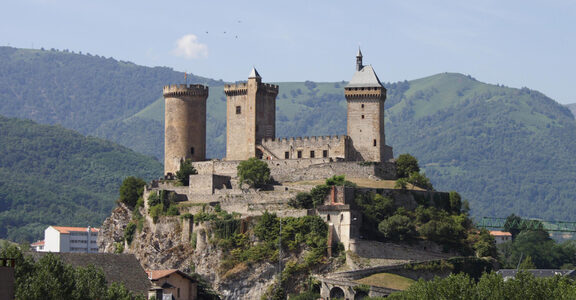
Do you dream of unlocking the mysteries of Cathar fortresses, but don’t know where to begin your exploration in Ariège? The Cathar castles of Ariège, veritable sentinels perched on the Pyrenean peaks, tell the captivating story of the Cathar resistance to the Albigensian crusade. Our itinerary guides you through seven emblematic sites, from Montségur to Miglos, via the majestic Château de Foix, to discover these medieval jewels steeped in history.
Montsegur Castle
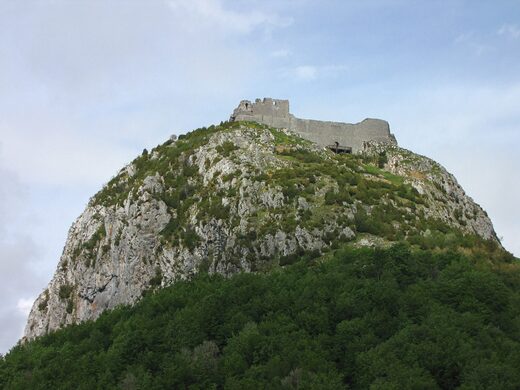
Perched on a “pog” at an altitude of 1207 meters, the Château de Montségur majestically dominates the Ariège Pyrenees. Located in the heart of the Ariège region, Montségur castle bears witness to a rich history. This Cathar fortress, visible from afar, was the seat of their church as early as 1232. Its strategic position made it an ideal refuge during the Albigensian Crusade.
In March 1244, after a grueling 11-month siege, over 200 Cathars perished at the stake at the foot of the castle. These men and women preferred martyrdom to denying their faith. Today, a stele commemorates this sacrifice, which marked the end of Cathar resistance in France. The site now attracts thousands of visitors fascinated by this dark page in medieval history.
Château de Roquefixade
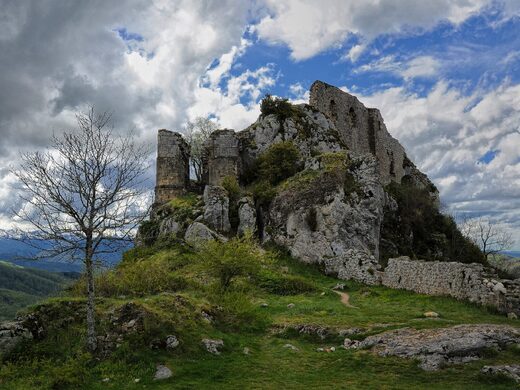
The Château de Roquefixade, perched on its limestone spur in the eastern Cathar Pyrenees, is a formidable testimony to the resistance to the Albigensian Crusade. Its first lords, the de Rabat family, fought alongside the Counts of Toulouse during this tumultuous period. Attested since 1034, this Ariège castle offers a unique perspective on Cathar history and the political struggles that shaped the region.
From the village of Roquefixade, a veritable balcony overlooking the Pyrenees, you can admire the majestic ruins that dominate the landscape. The fortress offers an exceptional panorama of the Lesponne valley, high Pyrenean peaks such as the Pic des Trois Seigneurs and the Montcalm massif. Accessible via the GR®367, the Cathar trail that links Port-la-Nouvelle to Foix, this medieval site transports you to another time.
Discover our points of interest and our tips for an unforgettable visit.
- Admire the panoramic view: Contemplate the Lesponne valley and the Pyrenean peaks.
- Take the GR®367: Follow the Cathar trail for a rewarding hike.
- Explore the fortifications: Discover the remains of medieval fortifications.
- Photograph the village: Capture the beauty of the hilltop village and its surroundings.
Don’t forget your camera to immortalize these moments.
Foix Castle
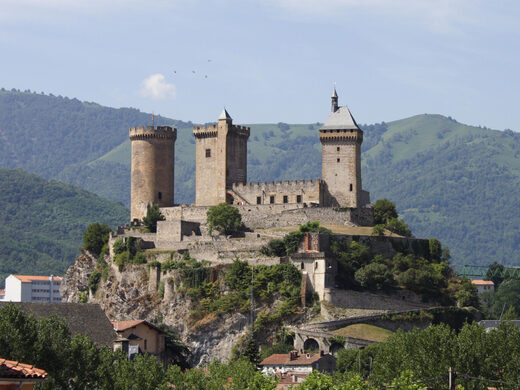
Perched on an impressive rocky outcrop overlooking the town at 450 meters above sea level, the Château de Foix impresses with its strategic position at the confluence of the Arget and Ariège rivers. First mentioned in the early 11th century, this jewel of the Pyrenees became the command center of the powerful Counts of Foix. Its unique position enabled them to control access to the upper Ariège valley, while ensuring their power between Comminges, Toulouse and Carcassonne.
Although Château de Foix held up remarkably well during the Albigensian Crusade, it is not considered a true Cathar castle. Counts Raymond-Roger and Roger-Bernard tolerated heretics, while their immediate entourage – wives, sisters and administrators – were often recognized as Cathars. These Ariege lords quickly realized that the crusade was mainly a pretext for the northern lords to plunder the riches of southern France.
Today, the Château de Foix offers an exceptional immersive experience in its departmental museum. You can relive the conquests and passions of the counts in rooms fitted out with reconstructed period furniture. Don’t miss the Escape Game on the Cathar Treasure, or the interesting workshops featuring medieval weapons, the forge and imposing war machines. The “Heroes & Heroines, from Antiquity to the Present” exhibition will take you on a journey through the different eras of the Middle Ages.
Château de Montaillou
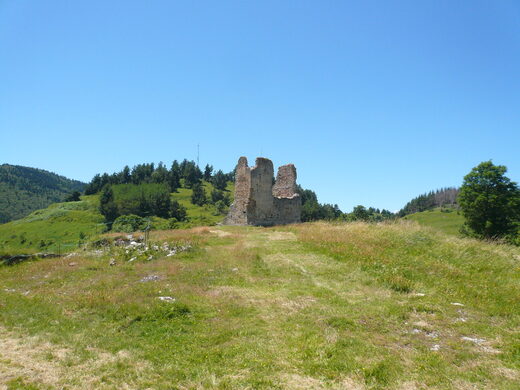
In the Cathar Pyrenees, Château de Montaillou stands out as the last bastion of Cathar resistance in the 12th century. Owned by the Sires d’Alion, Viscounts of Sault, this remarkable site became a privileged refuge for the Cathar Perfects, thanks to the favorable positions of its lords. Bernard d’Alion, who married the sister of the Count of Foix in 1236, enabled Montaillou to play a central role in the history of Catharism in the Ariege.
After its initial destruction, the castle was rebuilt as a strategic checkpoint against Aragon. Mentioned as early as 1272 as the fortress of the Count of Foix, it protected the county’s southern borders. Today, only a few sections of the keep walls remain, silent vestiges of a tormented era. The original stones were reused for other local buildings, gradually erasing all traces of this witness to Cathar history.
Château d’Usson
Château d’Usson is one of the oldest Cathar fortresses in Ariège, first mentioned in the 11th century. Owned by the lords of So and Alion, this stone sentinel controlled access to Donezan, a strategic territory in the Pyrenees. In times of religious conflict, the lords of Usson offered refuge to Cathar devotees fleeing persecution, particularly after the fall of Montségur.
This medieval fortress played an important role in the Cathar resistance. It served as a natural bulwark against Spanish invasions, and featured ingenious features such as a back door for discreet exits during sieges. Given this support for heretics, the Inquisition was quick to react with violence, condemning two members of the lordly family to the stake.
Today, the Maison du Patrimoine, housed in the former stables, plunges you into the fascinating history of Usson and Cathar country. Over 700 m² of exhibition space, you’ ll discover the evolution of Donezan from prehistoric times to the present day. From archaeological artefacts to explanatory slide shows and a reconstructed traditional mountain habitat, everything is designed to take you back in time.
The château also offers a wide range of activities to delight the whole family. Don’t miss the falconry shows, which evoke the medieval art of hunting, or the treasure hunts, which provide a fun way to discover the castle’s history. For nature lovers, there’s a botanical trail (approx. 1.5 hrs) where you can learn about the local flora that surrounds this Cathar fortress. Guided tours reveal all the secrets of this exceptional site.
Lordat Castle
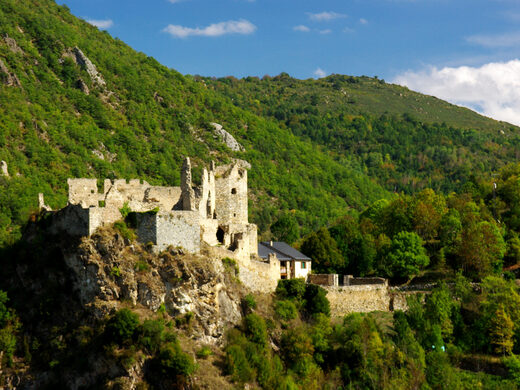
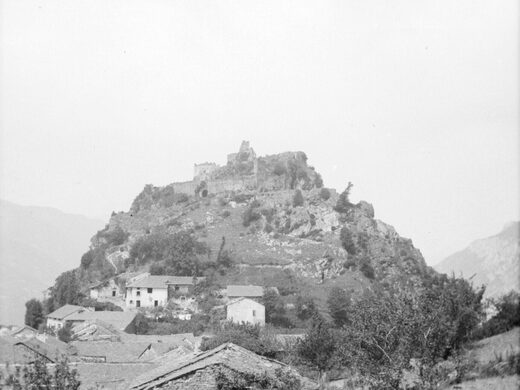
Discover the Château de Lordat, a medieval jewel dominating the upper Ariège valley. First mentioned in 970, this vast feudal castle became the property of Roger, first Count of Foix, in 1034. Its strategic location on a limestone outcrop made it an important control point for the Cathar Pyrenees. The remains still visible today bear witness to the importance of this fortress, which was also a refuge for the Cathars during the Albigensian Crusade.
From the Château de Lordat, you can admire a breathtaking panorama of the Sabarthès and its surrounding valleys. The site has seen a turbulent history between the Counts of Foix and the Kings of Aragon, who seized it at the end of the 13th century. Although dismantled by order of Henri IV in 1582, the château has been undergoing crystallization work since 1999 to preserve this precious testimony to medieval military architecture. Don’t miss a visit to this remarkable site, which reopened its doors to the public in 2016 and now offers summer events for the whole family.
Miglos Castle
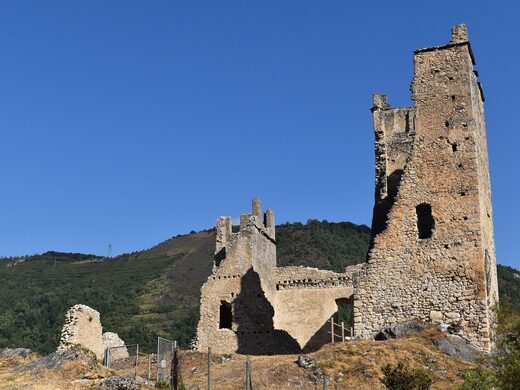
Perched on a limestone spur at an altitude of 779 meters, the Château de Miglos majestically dominates the Miglos and Vicdessos valleys in the Ariege Pyrenees. Dating back to the 12th century, this Cathar fortress once guarded access to the valley from its strategic position, communicating by signals with neighboring castles. Rising above the village of Capoulet, it is a testament to medieval defensive ingenuity.
Thanks to its ideal location, this castle provided command over the surrounding valleys, controlling access routes. In the Middle Ages, the only way to reach it was from Niaux to the village of Arquizat, which is now on the D156. Although the site is in ruins, you can still admire impressive remains such as the seigniorial dwelling and a 15-meter-high square tower. The Association des Amis du Château de Miglos organizes visits to help you discover this Ariège gem.
Here are the remarkable architectural features of the Cathar castles of Ariège.
- Strategic position: Castles are often located on rocky outcrops.
- Defensive systems: These include towers, curtain walls and loopholes.
- Local materials: Local limestone is used for construction.
- Adapting to the terrain: The architecture integrates with the natural constraints of the site.
These elements bear witness to the ingenuity of medieval builders.
Ariege castles comparison
Each of Ariège’s Cathar castles has its own unique personality and special interest. Montségur, a true symbol of Catharism at 1207 meters altitude, offers an intense historical immersion in the resistance to the Albigensian crusade. Roquefixade captivates visitors with its exceptional views of the Pyrenees and its unspoilt charm. Château de Foix, less directly linked to the Cathars but still an important part of the region’s history, offers the most interactive experience, with its departmental museum and daily family activities. Montaillou, more confidential, bears witness to the last fires of Cathar resistance, while Usson offers an educational approach with its museum space. Lordat is surprisingly ancient, almost a thousand years old, and Miglos, perched on a limestone spur, is a delight for lovers of authentic medieval architecture. To plan your trip and discover other exceptional sites, check out our guide to the 14 must-sees in Ariège.
| Château | Main interest | Ideal audience | Difficult access | Entertainment |
| Montségur | Emblematic Cathar history, panorama | History buffs, hikers | Medium (35 min walk) | Guided tours, village museum |
| Roquefixade | Panoramic view, architecture | Hikers, photographers | Average | GR®367 Cathar Trail |
| Foix | Architecture, interactive museum | Families, all publics | Easy (downtown) | Escape Game, medieval workshops |
| Montaillou | History of the Cathar resistance | Historians, archaeologists | Easy to medium | No |
| Usson | Museum space, Cathar refuge | Families, history buffs | Easy | Falconry, guided tours |
| Lordat | Old age, view of the Sabarthès | Lovers of medieval architecture | Average | Summer tours |
| Miglos | Authentic architecture | Hikers, photographers | Average | Orientation table |
Where to stay in Ariège ?
After exploring the Cathar castles of Ariège, extend your immersion in the history and landscapes of the Pyrenees with a stay in one of Marc & Montmija’s accommodations. These charming gîtes are ideally situated for exploring the various medieval fortresses, and allow you to take your time and savour the authenticity of the Ariège region. You’ll particularly appreciate the cosy comfort and warm welcome after your days exploring the steep paths of the Cathar castles. An ideal way to complete your itinerary in the heart of Cathar country and take full advantage of the magic of the Pyrenees.
This tour of the Cathar castles of the Ariège offers a unique journey through history and exceptional landscapes. From Montségur to Miglos, these medieval fortresses tell the story of Cathar resistance, transporting you back to the heart of the 13th century. Take the time to explore these stone sentinels that dominate the Pyrenean valleys and hold within them the memory of a fascinating era.
